
Internal Pine Doors
-
LPD Richmond Clear Pine Unglazed Half Internal Door CPRIC
Regular price £73.66Regular price -
LPD 2 Panel Clear Pine Half Door CP2P
Regular price £75.87Regular price -
LPD 3 Panel Clear Pine Half Internal Door CP3P
Regular price £75.87Regular price -
LPD Richmond Clear Pine Unglazed Internal Door CPRIC
Regular price £85.49Regular price -
LPD 6 Panel Clear Pine Internal Door CP6P
Regular price From £87.87Regular price -
LPD 4 Panel Clear Pine Internal Door CP4P
Regular price £88.04Regular price




About this range
- From
- £73.66
- Products
- 6
- Materials
- Pine
- Glazing
- Unglazed
- Brands
- LPD
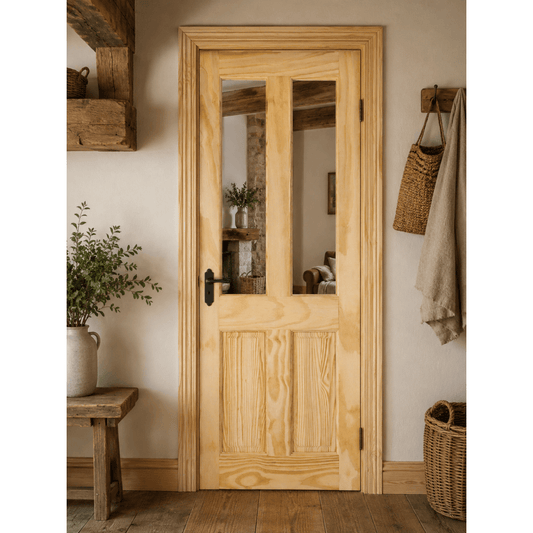
Pine is the only genuinely solid timber internal door most people will ever buy. Everything else on the market, oak and walnut included, is a veneer over an engineered core. A clear pine door is real softwood all the way through, which is why it can be stained, waxed, limed or painted, cut about more freely than a veneered leaf, and stripped back and started again decades later. This is a deliberately small range of six LPD designs from £73.66 to £88.04.
What clear pine means
Clear pine is the knot free grade. Knotty pine has its own following, but knots bleed resin through paint, move at a different rate to the surrounding timber and can loosen over years. Choosing clear grade removes that problem and gives an even surface for stain or paint. It is the reason a clear pine door costs more than the cheapest hollow flush leaf while still being one of the least expensive real timber doors available.
The six designs
Three are full width doors. The 4 Panel and 6 Panel designs are the classic Victorian and Edwardian arrangements and are the correct shape for a period British house. The Richmond is an unglazed vertical panelled design with a cleaner, less ornate face.
Three are half width doors, in 381mm, 457mm and 533mm widths. These are the narrow leaves used on pantries, airing cupboards, understairs stores and as pairs across a wide cupboard opening. They exist because period houses are full of openings that no standard door width fits, and finding a 381mm door is otherwise surprisingly difficult.
Sizes, including the awkward ones
The full width doors cover 1981mm x 610mm (78 x 24 inches), 686mm (78 x 27), 711mm (78 x 28), 762mm (78 x 30) and 838mm (78 x 33), plus metric 2032mm x 813mm (80 x 32). The 711mm width is worth noting because it is uncommon elsewhere and turns up regularly in 1930s housing. The half doors run 381mm, 457mm and 533mm. Because pine is solid, it takes trimming better than a veneered door, though the panel joints still set a practical limit. Check against our door size guide and how to measure a door.
Finishing pine properly
All of these doors are unfinished, and finishing them is not optional. Bare pine absorbs moisture quickly, so seal every face and all four edges including the top and bottom before hanging. This is the most common reason a new door sticks in a bathroom, and how to stop doors swelling covers it in detail.
Pine takes finish unevenly because the grain density varies, so a wood conditioner or a diluted first coat gives a far better result with stain than going straight on. Expect pine to yellow and deepen under a clear finish over the years, which some people like and some do not. A white or grey paint stops that entirely, and painting a solid pine door gives a better result than painting most engineered doors because there is no veneer to lift. The guide to door finishes and how to paint an interior door cover both routes.
Where pine doors make sense
Cottages, terraces, listed and conservation work, rental properties where doors get damaged and replaced, and any project where the door will be painted anyway. They are also the sensible choice for cupboards throughout a house, because the half widths solve openings nothing else fits. Pine is not the right answer if you want a factory finish and no work, in which case look at internal white primed doors for painted or internal oak doors for timber.
What pine does not do
None of these doors are fire rated, and pine is not the material to use where a rating is required. Fire doors are a different construction entirely, and the range is at fire doors. Pine also dents more easily than a hardwood veneer, which is worth knowing in a hallway with children and bikes.
Common questions
Are these doors solid?
Yes. Solid clear pine throughout, not a veneer over a core.
Can pine doors be stained to look like oak?
Reasonably close, using a wood conditioner first and building the colour in thin coats. It will never have oak grain, but from across a hallway the difference is small.
Do pine doors need painting on both sides?
Yes, and on all four edges. Finishing one face only lets the door take up moisture unevenly and twist.
Why are the half doors so narrow?
They are made for cupboards, pantries and understairs openings, and for hanging in pairs across a wide store. They are not intended as room doors.
What else do I need?
Hinges, a latch and a handle set per door. Door hinges, door handles and plan your doors cover the rest, and the full range is at internal doors.
Is pine ever on clearance?
Yes. Pine leaves such as the Victorian Burns with etched glass appear in clearance doors while stock lasts.
Fast delivery
Nationwide delivery, next-day available
Secure payment
Safe and encrypted checkout
Payment options
PayPal, cards and more
VAT included
Only delivery is added at checkout